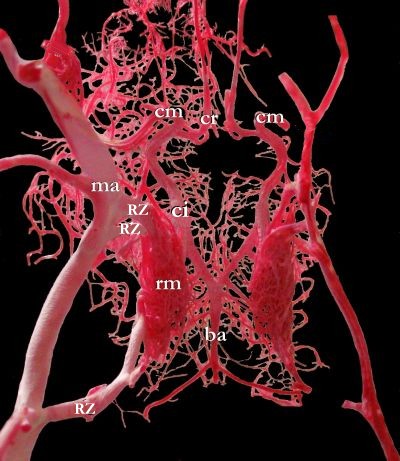
A rete mirabile (Latin for 'wonderful net'; plural retia mirabilia) is a complex of arteries and veins lying very close to each other, found in some vertebrates. The rete mirabile depends on countercurrent blood flow within the net (blood flowing in opposite directions.) It exchanges heat, ions, or gases between vessel walls so that the two bloodstreams within the rete maintain a gradient with respect to temperature, or concentration of gases or solutes.
The effectiveness of retia is primarily determined by how readily the heat, ions, or gases can be exchanged. And, for a given length they are most effective with respect to gases or heat, then small ions, and decreasingly so with respect to other substances. In birds with webbed feet, a rete mirabile in the legs and feet transfers heat from the outgoing (hot) blood in the arteries to the incoming (cold) blood in the veins, with the net effect that the internal temperature of the feet is much closer to the ambient temperature, thus reducing heat loss. In this example the rete mirabile functions as a biological heat exchanger. A similar structure is seen in other vertebrate extremities, including the neck of the dog, in order to protect the brain when the body overheats, mammalian testes, which are more productive at lower temperatures, fishes such as tuna, whose core temperature is higher than that of the cold deep waters they inhabit, and penguins who have them in the feet, flippers and nasal passages, to limit body heat lost to the cold environments in which they live.
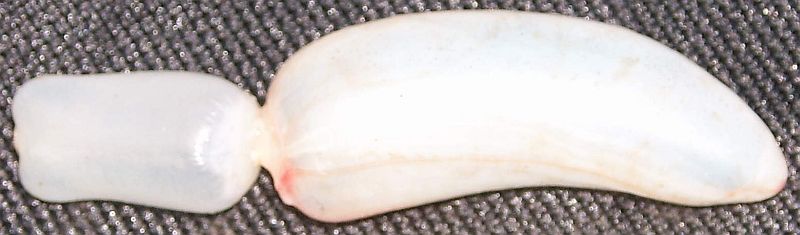
In some fish, a rete mirabile fills the swim bladder with oxygen, using a countercurrent exchange system where varying pH levels causes oxygen to unbind from blood hemoglobin and then come out of solution when the blood is supersaturated.
In giraffes, a rete mirabile in the neck equalizes blood pressure when the animal bends down to drink.
In mammals, an elegant rete mirabile in the efferent arterioles of juxtamedullary glomeruli is important in maintaining the hypertonicity of the inner zone of the renal medulla. It is the hypertonicity of this zone, resorbing water osmotically from the renal collecting ducts as they exit the kidney, that makes possible the excretion of a hypertonic urine and maximum conservation of body water.
The ancient physician Galen mistakenly thought that humans also have a rete mirabile in the neck, apparently based on dissection of sheep and misidentifying the results with the human carotid sinus, and ascribed important properties to it; it fell to Vesalius to demonstrate the error.
The effectiveness of retia is primarily determined by how readily the heat, ions, or gases can be exchanged. And, for a given length they are most effective with respect to gases or heat, then small ions, and decreasingly so with respect to other substances. In birds with webbed feet, a rete mirabile in the legs and feet transfers heat from the outgoing (hot) blood in the arteries to the incoming (cold) blood in the veins, with the net effect that the internal temperature of the feet is much closer to the ambient temperature, thus reducing heat loss. In this example the rete mirabile functions as a biological heat exchanger. A similar structure is seen in other vertebrate extremities, including the neck of the dog, in order to protect the brain when the body overheats, mammalian testes, which are more productive at lower temperatures, fishes such as tuna, whose core temperature is higher than that of the cold deep waters they inhabit, and penguins who have them in the feet, flippers and nasal passages, to limit body heat lost to the cold environments in which they live.
In some fish, a rete mirabile fills the swim bladder with oxygen, using a countercurrent exchange system where varying pH levels causes oxygen to unbind from blood hemoglobin and then come out of solution when the blood is supersaturated.
In giraffes, a rete mirabile in the neck equalizes blood pressure when the animal bends down to drink.
In mammals, an elegant rete mirabile in the efferent arterioles of juxtamedullary glomeruli is important in maintaining the hypertonicity of the inner zone of the renal medulla. It is the hypertonicity of this zone, resorbing water osmotically from the renal collecting ducts as they exit the kidney, that makes possible the excretion of a hypertonic urine and maximum conservation of body water.
The ancient physician Galen mistakenly thought that humans also have a rete mirabile in the neck, apparently based on dissection of sheep and misidentifying the results with the human carotid sinus, and ascribed important properties to it; it fell to Vesalius to demonstrate the error.